Builders Generation Technical Report
buildersgen.com
Abstract
Additive manufacturing is no longer only a rapid-prototyping method. In aerospace, robotics, sensing, and small spacecraft development, it is becoming a design and manufacturing framework for lightweight structures, electronics enclosures, payload mounts, mechanisms, thermal interfaces, and advanced polymer components. NASA’s survey chapter on Structures, Mechanisms, and Materials for SmallSats provides a useful technical lens for understanding where additive manufacturing is already practical, where conventional machined structures remain dominant, and how polymer material selection must be tied to mission environment, qualification evidence, and process control.
At Builders Generation, our primary learning from this survey is clear: the engineering value of additive manufacturing is not simply that a part can be printed. The value comes from matching geometry, material, process, post-processing, inspection, and application environment into a coherent manufacturing plan. For demanding systems—robotics, environmental sensing, aerospace-adjacent payloads, electronics packaging, and advanced polymer hardware—the printed component should be treated as an engineered artifact, not a commodity output.
1. Introduction: Additive Manufacturing as an Engineering System
NASA’s SmallSat structures survey describes a major transition in spacecraft development: additive manufacturing has moved from secondary brackets and fit-check components toward custom structural solutions, including some primary-structure applications in small CubeSats and PocketQubes. The survey also remains appropriately conservative: larger CubeSats and ESPA-class SmallSats still frequently rely on conventionally machined aluminum alloys for primary structures because their properties, interfaces, and qualification histories are better understood.
This distinction is important for any engineering manufacturing company. Additive manufacturing is powerful, but the process does not erase the fundamentals of structural design. A load-bearing component must still satisfy stiffness, strength, toughness, thermal stability, dimensional control, vibration survival, environmental compatibility, and inspection requirements.
The central lesson is that additive manufacturing should be viewed as a process-qualified design space. A printed part is not defined only by its CAD file. It is defined by:
- the selected material,
- the printer architecture,
- the build orientation,
- the toolpath strategy,
- layer bonding and anisotropy,
- post-processing,
- dimensional inspection,
- environmental exposure,
- and the evidence package supporting its intended use.
For Builders Generation, this aligns with our philosophy: additive manufacturing is strongest when integrated with design-for-additive manufacturing, material selection, documentation, and application-specific review.
2. Primary and Secondary Structures: Why Classification Matters
NASA’s chapter separates spacecraft structures into primary and secondary categories. A primary structure is mission-critical: if it fails, the mission can fail catastrophically. A secondary structure may not carry the main launch or flight loads, but it can still affect mission performance by supporting electronics, thermal blankets, solar panels, sensors, and subsystem hardware.
For small spacecraft, this distinction can blur. Volume is tightly constrained, and a single component may serve several functions at once: mechanical support, thermal path, radiation mass, electronics mounting, cable routing, and environmental protection. NASA notes that this multifunctionality is especially important in SmallSats because the available volume is constrained by dispensers or deployment rings.
This lesson applies directly outside spaceflight as well. In robotics, drones, autonomous vehicles, and environmental monitoring systems, a sensor enclosure may simultaneously act as:
- a structural bracket,
- an electronics carrier,
- a vibration isolator,
- a thermal dissipation path,
- a sealing interface,
- a cable-management feature,
- and a service-access mechanism.
A part with that level of functional coupling should not be treated as a generic “printed part.” It should be reviewed as a system component.
3. Structural Architectures: Monocoque, Modular Frames, and Card-Slot Systems
NASA’s survey reviews several structural architectures in the SmallSat market. These architectures also provide useful design patterns for terrestrial robotics and advanced electronics packaging.
3.1 Monocoque Structures
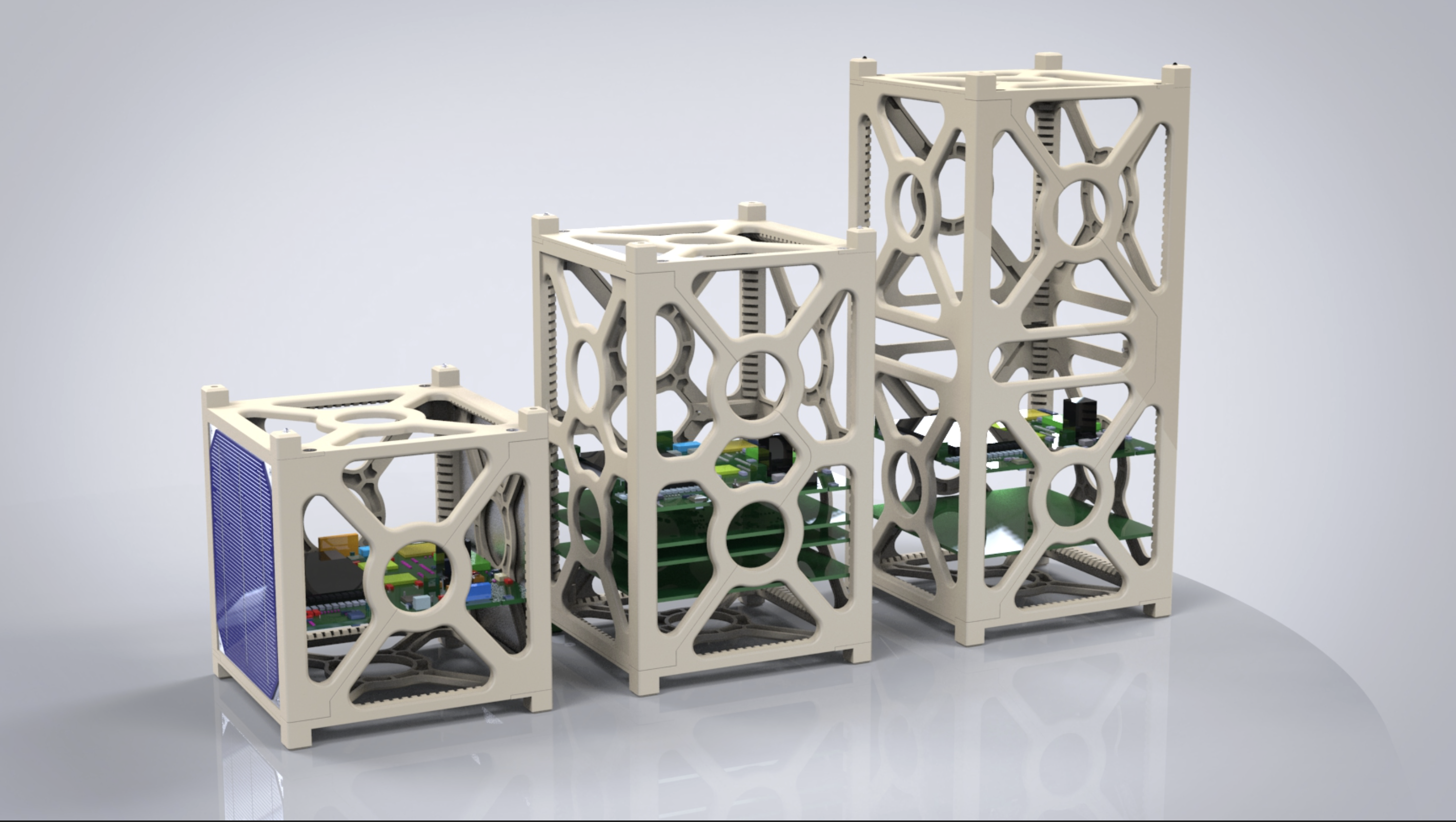
Monocoque structures carry loads through the external skin. In aerospace, this approach has a long history because it can improve stiffness-to-mass efficiency and maximize internal volume. NASA notes that monocoque SmallSat structures can provide thermal mass, increase mounting surface area, and potentially reduce radiation dose by placing more material around sensitive electronics.
For additive manufacturing, monocoque thinking is highly relevant. AM enables integrated skins, ribs, bosses, cable channels, captive features, and organic reinforcement patterns that may be difficult or expensive to machine conventionally. However, printed monocoque parts must still be evaluated for anisotropy, local stress concentration, layer bonding, thermal expansion, and inspection accessibility.
3.2 Modular Frames
Modular frame structures use rails, panels, and repeatable interface elements to allow flexible payload integration. NASA highlights that modular CubeSat frames support quick-turn missions and help maintain strict external dimensional requirements. The tradeoff is that open modular frames may provide less radiation shielding and less thermal mass than closed monocoque designs.
This is a useful model for Builders Generation’s work in robotics and sensing systems. Modular frame design can support:
- quick sensor swaps,
- electronics stack revisions,
- payload reconfiguration,
- field repair,
- service access,
- and design iteration without rebuilding the entire assembly.
For customers building drones, rovers, edge-AI payloads, LiDAR sensor packages, thermal imaging systems, or gas-sensing modules, modularity can reduce development risk.
3.3 Card-Slot and Backplane Systems
One of the most relevant sections of the NASA survey for modern AI hardware is the discussion of card-slot and backplane systems. These systems mechanically support electronics cards on rails and electrically connect them through standardized backplanes. NASA notes that such architectures can support integration, thermal conduction, access to individual modules, and late-stage hardware or software changes.
This is directly applicable to high-power edge computing. AI/ML payloads using GPUs, FPGAs, single-board computers, camera processors, LiDAR interfaces, and radio modules create thermal, mechanical, and serviceability challenges. Additive manufacturing can support custom chassis designs that borrow from card-slot architecture while remaining specific to the application.
For Builders Generation, this points toward a valuable design category:
Modular payload enclosures for electronics, sensing, robotics, and edge-AI systems.
These are not simply boxes. They are structural, thermal, and integration platforms.
4. Technology Readiness: Why “Printed in PEEK” Is Not the Same as “Qualified”
One of the most important scientific points in the NASA chapter is that the Technology Readiness Level of an additively manufactured part cannot be assigned to the printer or material alone. NASA states that AM system maturity and part readiness are different questions: the readiness of a printed component depends on the specific material, part configuration, manufacturing process, post-processing, testing, qualification process, and application environment.
This is a critical concept for advanced manufacturing.
For example, “nylon” is not one material outcome. Nylon printed by fused filament fabrication may have different mechanical behavior from nylon produced by selective laser sintering. Even within FFF, the same nylon filament can produce different performance depending on moisture content, extrusion temperature, chamber temperature, build orientation, raster pattern, annealing, and geometry.
Therefore, responsible additive manufacturing should avoid unsupported claims such as:
- “This material is aerospace-certified.”
- “This printer makes flight-ready parts.”
- “PEEK is automatically space-grade.”
- “Carbon fiber nylon is equivalent to aluminum.”
- “A printed part is qualified because the material datasheet looks strong.”
A more accurate framework is:
Part readiness = material + machine + geometry + process + post-processing + inspection + test evidence + operating environment.
At Builders Generation, this motivates a qualification-aware service model. For engineering programs, we can support customers with documented build orientation, material choice, process notes, dimensional inspection, and a recommended validation path. For flight, medical, pressure, safety-critical, or regulated use, final qualification must be tied to the customer’s requirements, test standards, and acceptance criteria.
5. Inspection and Testing: The Bridge Between Prototype and Engineering Hardware
NASA emphasizes that when new materials or processes are used, testing is necessary to reduce risk and close the gap between lower and higher TRL levels. The chapter specifically calls out mechanical, modal, and thermal testing as important when comparing a new material or process against a known structural design.
This is where additive manufacturing matures from a design tool into an engineering process.
A useful validation ladder for AM parts is:
| Stage | Objective | Evidence |
|---|---|---|
| Concept prototype | Validate shape, packaging, and assembly logic | CAD, print notes, visual inspection |
| Fit-check article | Validate interfaces and installation | Dimensional inspection, tolerance review |
| Functional prototype | Validate load path and usability | Application testing, fastener checks, assembly cycling |
| Engineering article | Validate material/process behavior | Test coupons, build orientation record, post-processing record |
| Environmental candidate | Validate performance under relevant exposure | Thermal, vibration, humidity, chemical, ESD, or UV testing |
| Qualification candidate | Build repeatability and acceptance evidence | Lot traceability, inspection report, test report, customer acceptance criteria |
For Builders Generation, this is the difference between commodity printing and engineering-grade AM. We do not need to claim every part is certified. Instead, we should support a disciplined pathway from prototype to qualification-ready hardware.
6. Polymer AM Process Families: FFF, SLA/DLP, PolyJet, and SLS
NASA identifies three primary polymer AM families: fused filament fabrication, stereolithography using photopolymer resin, and selective laser sintering using powder. Within resin systems, NASA distinguishes DLP and PolyJet-type processes.
Each process family has a different engineering profile.
6.1 FFF / FDM
FFF is widely used for thermoplastics such as PLA, ABS, nylon, polycarbonate, PEI, PEEK, and PEKK. Its strengths include material diversity, low tooling cost, rapid iteration, and access to engineering thermoplastics. Its limitations include anisotropic mechanical properties, visible layer lines, surface finish constraints, support requirements, and strong dependence on thermal control.
FFF is especially useful for:
- functional prototypes,
- brackets,
- fixtures,
- electronics enclosures,
- drone and robot payload parts,
- high-temperature polymers when printed on appropriate equipment,
- ESD-safe or carbon-filled materials when selected correctly.
6.2 SLA / DLP Photopolymers
SLA and DLP use liquid photopolymers cured by light. NASA notes that photopolymer processes can produce high-resolution, isotropic parts and optical-quality features, and some photopolymer formulations offer high temperature resistance and strength.
Resin systems are useful for:
- precision fit-checks,
- fine features,
- smooth surfaces,
- small fluidic channels,
- optical-adjacent prototypes,
- medical and laboratory models,
- high-detail enclosures,
- small complex parts.
However, photopolymers require careful attention to post-curing, brittleness, long-term stability, UV exposure, chemical exposure, and thermal behavior.
6.3 SLS
SLS uses powder, commonly nylon-based materials, and generally produces more isotropic parts than FFF because components are fused in a powder bed rather than deposited as individual roads. NASA highlights Windform materials as carbon-fiber-reinforced polymers manufactured by SLS, with improved dimensional stability and more isotropic properties than FFF.
SLS is useful for:
- complex geometries without support structures,
- batch production,
- lightweight lattice geometries,
- ducting,
- housings,
- brackets,
- integrated assemblies,
- and applications where FFF anisotropy is undesirable.
7. Material Survey: Lessons for Engineering Selection
NASA’s material survey is valuable because it does not treat polymers as interchangeable. Each material class has a different balance of printability, strength, stiffness, thermal resistance, outgassing, ESD behavior, moisture sensitivity, surface finish, and qualification potential.
7.1 PLA: Excellent for Early Prototypes, Limited for Harsh Use
PLA is easy to print, low-warp, inexpensive, and useful for visual models and fit checks. NASA notes that PLA has low shrinkage and is easy to print because it does not require high nozzle, bed, or chamber temperatures. However, NASA does not recommend PLA beyond low TRL applications unless the exposure is short-term and tightly controlled.
Builders Generation takeaway:
PLA is a good concept and fit-check material, not a default engineering material for demanding thermal, structural, or environmental applications.
7.2 ABS: Useful but Process-Sensitive
ABS offers better toughness and temperature resistance than PLA, but it is more difficult to print due to shrinkage, warping, and thermal-gradient sensitivity. NASA notes that enclosed systems with heated chambers print ABS more effectively, and also references an ABS flight use case in KickSat-2 where a complex single-use deployer structure made conventional machining unattractive.
Builders Generation takeaway:
ABS can be appropriate for rugged prototypes and some functional parts, but large or tolerance-sensitive ABS components should be designed around shrinkage, enclosure temperature, and post-processing needs.
7.3 Nylon and Carbon-Filled Nylon: Tough, Useful, and Moisture-Sensitive
Nylon is a versatile engineering polymer with strong toughness and wide formulation diversity. NASA notes that nylon is generally more difficult to print than ABS on open-source FFF systems because it benefits from thermal stability, enclosure control, and careful bed preparation. The chapter also notes use of Markforged Onyx carbon-fiber filaments in secondary structural pieces through the TechEdSat program.
Builders Generation takeaway:
Nylon and carbon-filled nylon are strong candidates for robotics, drones, jigs, fixtures, sensor mounts, and functional prototypes, but moisture control, print orientation, and load direction must be handled intentionally.
7.4 Polycarbonate: Impact-Resistant, Stiff, and Difficult to Print Well
Polycarbonate has high impact resistance, stiffness, tensile strength, and temperature resistance. NASA notes that PC is dimensionally stable after manufacture but difficult to print on open-frame systems because of warping, high bed/nozzle requirements, adhesion challenges, and hygroscopic behavior.
Builders Generation takeaway:
Polycarbonate is a strong candidate for ruggedized enclosures and impact-resistant parts, but it should be printed with controlled process conditions and material drying.
7.5 PEI / ULTEM: High-Performance, Low-Outgassing, and Process-Demanding
PEI, often known by the ULTEM trade name, is highlighted by NASA as a tough thermoplastic with high thermal and chemical stability, inherent flame resistance, machinability, and low outgassing. NASA also notes that PEI is practically printable on commercial FFF systems because of the thermal control required.
Builders Generation takeaway:
PEI is appropriate for advanced engineering programs where flame resistance, thermal stability, chemical resistance, and low outgassing matter—but it should be treated as a qualified-project material, not a casual commodity print.
7.6 PEEK, PEKK, and PAEK: Premium Advanced Polymers
NASA describes PEEK and PEKK, part of the PAEK family, as among the highest-performing thermoplastics covered in the survey. The chapter notes that these materials can withstand high continuous temperatures in some formulations after annealing, are naturally flame-retardant, have low outgassing, and are relevant for optical and space-compatible applications. NASA also emphasizes that these polymers require extreme manufacturing conditions, high-cost feedstock, and robust FFF systems with sealed and heated chambers.
Builders Generation takeaway:
PEEK and PEKK should be offered as advanced-polymer candidates for qualified projects, with explicit process review, geometry review, chamber capability review, drying, annealing strategy, and acceptance criteria.
This is especially important for website language. It is more credible to say:
“PEEK/PEKK available for qualified advanced-polymer projects after engineering review”
than to imply:
“We print aerospace-certified PEEK parts on demand.”
7.7 Photopolymers: High Resolution, Isotropy, and Specialized Formulations
NASA notes that photopolymer processes can provide superior isotropic material properties, high resolution, and optical-quality parts. Some photopolymer formulations are designed for extreme temperature resistance and strength, and some have heat deflection temperatures comparable to or greater than some PAEK materials.
Builders Generation takeaway:
SLA/DLP resins are not only “pretty prototype” materials. With proper selection and post-processing, they can support precision fixtures, microfluidic concepts, optical-mechanical prototypes, electronics packaging, and application-specific engineering parts.
However, resin materials must be evaluated for brittleness, long-term exposure, thermal cycling, UV stability, chemical compatibility, and outgassing when used in demanding environments.
8. Electrostatic Discharge, Volume Resistivity, and Space-Environment Awareness
A particularly important section of the NASA survey concerns electrostatic discharge. In space, surface charging can occur when spacecraft materials interact with plasma environments. NASA notes that field buildup and ESD can negatively affect spacecraft, and references guidance that dielectric materials above 10¹² Ω·cm should be avoided because charge accumulation can occur. Volume resistivity and dielectric constant are identified as important properties for evaluating electrostatic discharge risk.
For Builders Generation, this lesson extends beyond spacecraft.
ESD-sensitive environments include:
- satellite electronics,
- avionics,
- semiconductor handling,
- sensor modules,
- high-voltage systems,
- robotics control boards,
- battery systems,
- test fixtures,
- and industrial electronics packaging.
A polymer enclosure that is mechanically strong may still be unsuitable if it accumulates charge, contaminates optics, traps heat, or shifts dimensions under thermal cycling. This is why material selection must consider more than tensile strength.
A serious AM material review should include:
| Property | Why it matters |
|---|---|
| Tensile strength | Load-bearing capability |
| Flexural strength | Bending stiffness and panel behavior |
| Impact resistance | Shock and field durability |
| Heat deflection temperature | Thermal service limit |
| Coefficient of thermal expansion | Dimensional drift and alignment |
| Moisture absorption | Dimensional stability and electrical behavior |
| Volume resistivity | ESD risk |
| Outgassing | Optical, vacuum, and sensor contamination |
| Density | Mass budget |
| Flame/smoke/toxicity | Aerospace and enclosed environments |
| Print anisotropy | Layer-direction failure risk |
| Post-processing response | Annealing, curing, machining, coating |
This is where Builders Generation can differentiate itself: by offering material selection as an engineering decision, not simply a menu of printable plastics.
9. Radiation, Shielding, and Material Architecture
NASA includes radiation effects because radiation exposure can influence structural design. In SmallSats operating beyond benign low-Earth-orbit conditions, designers may need to consider total ionizing dose, solar particle events, polar low-Earth orbit exposure, interplanetary environments, and electronic subsystem vulnerability.
For additive manufacturing, this creates two design questions.
First, can the structure provide inherent mass shielding? A closed or semi-closed enclosure may provide more protection than an open frame. Monocoque structures, for example, may provide more surrounding mass than highly open modular frames.
Second, can material distribution be tailored? AM makes it possible to vary wall thickness, lattice density, local reinforcement, standoff geometry, and sacrificial shielding zones. That does not automatically qualify a part for radiation protection, but it expands the design space for integrated shielding and structural efficiency.
For Builders Generation, the correct claim is not that we “make radiation-shielded space parts” by default. A better and technically sound position is:
“We support geometry and material strategies for environment-aware enclosures, including mass distribution, wall-thickness planning, electronics packaging, ESD-aware material selection, and test-candidate development.”
10. Design Optimization: The Real Advantage of Additive Manufacturing
NASA states that AM frees designers from some constraints of conventional manufacturing and allows monolithic structural elements with complex geometry. It also notes that AM has a distinct design space and increasingly integrates with CAD, CAM, modal analysis, and structural analysis tools.
This is the core business opportunity.
The greatest value of additive manufacturing is not that a conventional machined part can be copied layer by layer. It is that the part can be redesigned around:
- mass reduction,
- topology optimization,
- lattice structures,
- conformal surfaces,
- integrated cable channels,
- embedded fastener features,
- reduced part count,
- thermal pathways,
- sensor placement,
- vibration isolation,
- inspection access,
- and assembly simplification.
A bracket does not have to remain a block with holes. A sensor housing does not have to remain a rectangular box. A drone payload mount can combine cable routing, heat relief, vibration isolation, connector access, and aerodynamic packaging. A robot end-effector can combine compliance, internal routing, and replaceable interfaces.
At Builders Generation, the most valuable offering is therefore not “send us an STL and we print it.” The stronger offering is:
Design-for-additive manufacturing from concept to documented engineering hardware.
11. Practical Framework for Builders Generation Customers
Based on the NASA survey, Builders Generation can organize project intake around five engineering questions.
11.1 What is the function of the part?
Is it cosmetic, ergonomic, structural, thermal, electrical, environmental, or multifunctional?
11.2 What is the operating environment?
Temperature, humidity, UV, vibration, chemicals, vacuum, ESD sensitivity, load cycles, and exposure duration matter.
11.3 What failure mode matters most?
Possible failure modes include fracture, creep, delamination, thermal distortion, fastener pullout, cracking, charge buildup, surface wear, contamination, or dimensional drift.
11.4 What material family fits the risk profile?
Early prototypes may use PLA or standard resins. Functional prototypes may use PETG, ABS, ASA, nylon, carbon-filled nylon, PC, or engineering resins. Demanding applications may require PEI, PEEK, PEKK, ESD-safe polymers, or specialized photopolymers.
11.5 What evidence is needed?
A concept model may need only a print note. A functional part may need dimensional inspection. A production candidate may need process records, material traceability, test coupons, and acceptance criteria.
This framework can become part of Builders Generation’s customer-facing engineering process.
12. Builders Generation Positioning: Qualification-Aware, Not Overstated
The NASA survey supports a careful and credible market position for Builders Generation:
Builders Generation develops advanced additive-manufactured structures, enclosures, fixtures, and payload hardware for robotics, aerospace-adjacent systems, sensing platforms, and engineering teams that need more than commodity 3D printing.
The key phrase is qualification-aware. It communicates that we understand the path from prototype to production candidate without claiming that every printed component is certified for flight, pressure, medical, or safety-critical use.
A clearer customer-facing statement:
At Builders Generation, we treat additive manufacturing as an engineering process. Material choice, geometry, print orientation, post-processing, inspection, and operating environment all shape the final performance of a part. Inspired by aerospace qualification practices, we help customers move from concept models to functional prototypes, documented engineering builds, and qualification-ready production candidates.
13. Recommended Builders Generation Material Tiers
A practical material framework based on the survey:
| Tier | Materials | Use case |
|---|---|---|
| Concept | PLA, standard draft resin | Visual models, early fit checks |
| Functional prototype | PETG, ABS, ASA, nylon, engineering resin | Brackets, enclosures, jigs, assembly validation |
| Field-ready engineering | Carbon-filled nylon, PC, tough resin, high-temp resin, ESD-safe materials | Drone/robot parts, electronics housings, tooling |
| Advanced polymer | PEI/ULTEM, PEEK, PEKK, PPSU, PPS, ESD-safe PAEK candidates | High-temp, low-outgassing, flame-resistant, aerospace-adjacent applications |
| Process-specific partner path | SLS nylon, MJF PA12, Windform-like SLS composites, metal AM if required | Isotropic batch production, complex support-free geometries, higher-volume production |
This tiering helps customers understand why material choice is not arbitrary.
14. What We Learned from Aerospace AM
NASA’s review of SmallSat structures and materials shows that additive manufacturing is most valuable when it is tied to material science, structural design, process documentation, and testing. A printed part is not qualified because of the printer alone. Its performance depends on material, geometry, build orientation, post-processing, inspection, and operating environment. Builders Generation applies this mindset to robotics, sensing, aerospace-adjacent hardware, and advanced product development.
For Builders Generation customers, the practical takeaway is that material choice, process control, and validation planning should happen before a part is treated as field-ready or qualification-ready.
15. Conclusion
NASA’s SmallSat structures and materials survey provides a clear technical message: additive manufacturing has matured into a serious engineering method, but its successful use depends on disciplined material selection, geometry optimization, process control, and validation. The survey shows promise in polymer AM for secondary spacecraft structures, custom frames, mechanisms, advanced thermoplastics, photopolymers, ESD-aware materials, and mass-optimized components. It also reinforces the continued role of machined aluminum and conventional structures where flight heritage, isotropy, thermal behavior, and qualification evidence are essential.
For Builders Generation, the lesson is not to claim that every printed part is automatically aerospace-grade. The stronger and more defensible position is that we provide qualification-aware additive manufacturing: a disciplined path from design and material selection to functional prototypes, documented engineering builds, and production-ready hardware candidates.
In the next generation of robotics, environmental sensing, drones, edge-AI systems, and aerospace-adjacent platforms, the winning components will not simply be printed. They will be designed, manufactured, inspected, and validated as integrated engineering systems.
Source Note
This article interprets NASA’s 2024 State-of-the-Art Small Spacecraft Technology report, Chapter 6: Structures, Materials, and Mechanisms: https://www.nasa.gov/smallsat-institute/sst-soa/structures-materials-and-mechanisms/