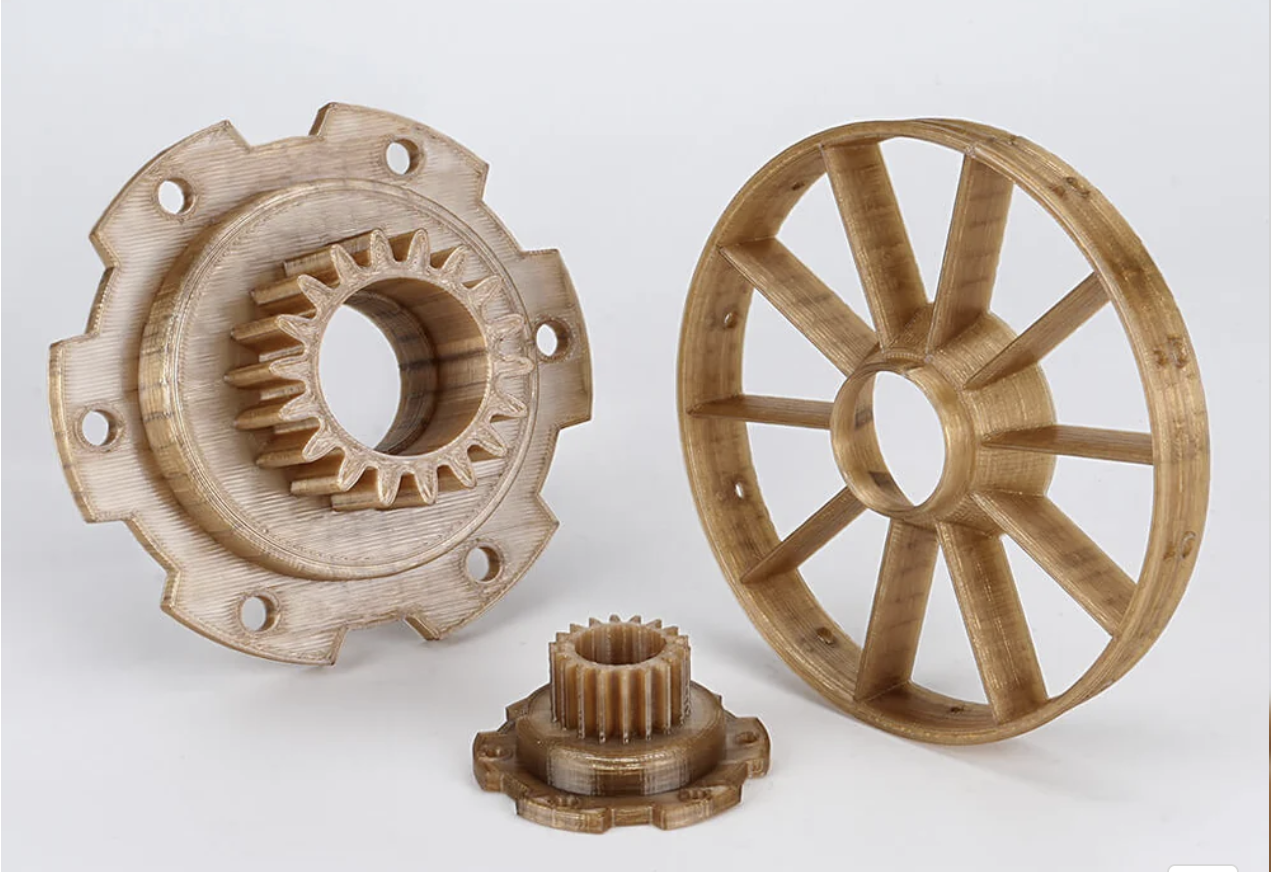
Carbon fiber-filled polymers have become the default first answer when an engineer needs more stiffness than unfilled nylon or polycarbonate can provide. That's a reasonable starting point — but "carbon fiber composite" covers a wide range of materials with meaningfully different performance profiles, and selecting by fiber presence alone misses the properties that actually govern service life.
PA-CF, PC-CF, and PPS-CF are three distinct engineering materials. They share a chopped carbon fiber fill that boosts flexural modulus and reduces mass, but the polymer matrix in each case determines the temperature ceiling, impact response, chemical resistance, moisture sensitivity, and print behavior. Choosing the wrong matrix for the application doesn't just leave performance on the table — it produces parts that creep in heat, embrittle in cold, corrode in solvent exposure, or absorb moisture until dimensional tolerances drift.
This guide covers the performance profile of each material, the application conditions that favor each, and a decision framework for the most common hardware engineering scenarios.
The Matrix Determines More Than the Fiber
Before the material comparison, one clarification: in any short-fiber composite, the fiber governs stiffness and contributes to strength, but the polymer matrix governs almost everything else — thermal ceiling, chemical resistance, impact toughness, moisture absorption, and creep behavior.
A part rated to 100 °C continuous service is rated to 100 °C because the matrix softens or creeps at that temperature, not because the carbon fiber runs out of capability. A part that embrittles at -30 °C embrittles because the matrix undergoes a glass transition below that temperature. Chemical attack on the part surface is attack on the matrix.
This means selecting a CF composite by fiber content alone — "I need CF for stiffness, so any CF material will do" — produces application failures that look random but are fully predictable from the material datasheet. The matrix choice must be deliberate.
PA-CF: Stiffness-to-Weight Champion for Structural Hardware
Polymer matrix: Nylon (polyamide), typically PA-6 or PA-12 Fiber content: 20–30% short chopped carbon fiber Flexural modulus: 5,000–5,500 MPa Density: 1.10–1.15 g/cm³
Why PA-CF Wins for Structural Brackets and Frames
The PA-CF value proposition is high stiffness at low density with printability that is achievable on capable FFF hardware. At a flexural modulus of ~5,460 MPa and density of ~1.12 g/cm³, the specific stiffness (modulus per unit density) approaches that of aluminum 6061 while delivering mass savings of 55–60% part-for-part on equivalent geometry.
For robotics frames, UAV structural arms, drone landing gear, and equipment mounts that are load-bearing but not exposed to extreme temperatures or harsh chemicals, PA-CF delivers the stiffness that unfilled nylon cannot while staying within the temperature envelope most structural hardware operates in.
Tensile strength: 100–130 MPa (XY orientation) HDT at 1.8 MPa: 180–200 °C (well above typical ambient structural applications) Continuous use temperature: 85–100 °C
The Moisture Absorption Caveat
Nylon matrices absorb moisture. PA-CF absorbs less than unfilled PA-12 because the carbon fiber reduces the polymer volume fraction, but it still absorbs 0.5–1.5% moisture by weight in humid environments. Moisture absorption affects:
- Dimensional stability — absorbed water acts as a plasticizer, causing slight swelling. For tight-tolerance features (press fits, alignment pins), the as-printed dry dimensions will drift in a high-humidity environment.
- Mechanical properties — moisture absorption lowers yield strength and increases ductility. For outdoor-deployed structural parts, design allowables should account for the wet condition.
Mitigation: design with generous tolerances on mating features if deployed in humid environments, or seal critical surfaces. For precision interfaces in uncontrolled humidity, PC-CF is the better matrix choice.
Where PA-CF Is the Right Call
- Structural robot joints, arm segments, frame cross-members
- UAV landing gear struts and motor mounts (indoor/controlled environment)
- Equipment brackets in ambient temperature, moderate humidity
- Prototype-to-production structural hardware where mass and stiffness are primary drivers and the operating temperature stays below 85 °C
PC-CF: Impact Toughness and Cold-Temperature Performance
Polymer matrix: Polycarbonate Fiber content: 10–20% short chopped carbon fiber Flexural modulus: 5,500–6,500 MPa Density: 1.20–1.25 g/cm³ Notched Izod impact: 80–120 J/m (versus 30–50 J/m for PA-CF)
Why Polycarbonate Changes the Impact Equation
The polycarbonate matrix is inherently tough. Unfilled PC is the material of choice for ballistic-grade transparencies, riot shields, and electronics housings that must survive repeated mechanical shock — and the carbon fiber fill reinforces it without eliminating that toughness.
The result is a CF composite that is substantially more impact-resistant than PA-CF or PPS-CF. For applications that see repeated dynamic loading, shock events, dropped equipment scenarios, or end-effector forces that produce load spikes rather than sustained loads, PC-CF absorbs and distributes those events in ways PA-CF cannot.
Cold temperature performance: PC matrix retains ductility to -40 °C. PA-CF and PPS-CF become more brittle at sub-zero temperatures. For hardware deployed in cold climates, arctic environments, or cold-chain applications, PC-CF's cold toughness is a genuine differentiator.
The Temperature Ceiling
PC softens progressively above 120–130 °C and should not be used for sustained loads above 110 °C. This eliminates PC-CF from engine-adjacent applications, motor bracket applications with significant heat soaking, and any part that must maintain dimensional stability above 115 °C.
HDT at 1.8 MPa: 130–145 °C Continuous use temperature: 110–120 °C
Moisture: Better Than Nylon, Not Zero
Polycarbonate absorbs less moisture than nylon — typically 0.1–0.3% by weight versus 0.5–1.5% for PA-CF. For precision-tolerance applications in variable humidity, PC-CF holds dimensional stability significantly better than PA-CF.
Where PC-CF Is the Right Call
- End-effectors and grippers: stiff and impact-tolerant for contact-force applications
- Electronics enclosures and sensor housings requiring both stiffness and shock resistance
- Hardware deployed in cold environments (-40 °C operating range)
- Drone and UAV housings subject to crash/impact loads (landing, collision)
- Structural connectors in assemblies where fatigue impact loading is the dominant failure mode
PPS-CF: Chemical Resistance and Thermal Ceiling
Polymer matrix: Polyphenylene sulfide (PPS) Fiber content: 30–40% short chopped carbon fiber Flexural modulus: 11,000–15,000 MPa Density: 1.45–1.55 g/cm³ HDT at 1.8 MPa: 240–265 °C Continuous use temperature: 200–220 °C
The Highest Stiffness in the FFF CF-Composite Tier
PPS-CF reaches flexural moduli that none of the other standard CF composites approach. At 11,000–15,000 MPa, it is stiffer than CF-PEEK in many formulations — though CF-PEEK has the higher strength ceiling and broader design database.
For applications where stiffness is the critical metric — heat-soak conditions that eliminate PC-CF and PA-CF, and the application does not require PEEK-level chemical pedigree or fatigue cycling — PPS-CF's modulus and temperature combination is unmatched in cost-effective FFF composites.
Chemical Resistance: The PPS Advantage
PPS is inherently resistant to most organic solvents, hydraulic fluids, fuels, lubricants, and cleaning agents. The resistance profile:
- Excellent: Jet fuels (Jet A, Jet A-1), hydraulic fluids (Skydrol), machine oils, greases, most cleaning solvents — PPS-CF rates 4.8/5 on a fuel resistance scale against Jet-A; PC-CF rates 2.5/5 against the same fluid
- Good: Dilute acids, dilute bases, most alcohols
- Marginal: Strong oxidizing acids at elevated temperature
For sensor housings, brackets, and fluid handling components that see chemical splash in industrial, automotive, or aerospace environments, PPS-CF's chemical resistance exceeds both PA-CF and PC-CF.
The Density Trade-Off
PPS-CF is the heaviest of the three composites at 1.45–1.55 g/cm³. This is not a problem for applications where stiffness and thermal performance are primary — but for mass-critical UAV and satellite applications, PEEK or CF-PEEK is typically preferred because the PPS density penalty is not offset by a stiffness advantage in most application geometries.
Where PPS-CF Is the Right Call
- Motor brackets and heat-path components where sustained temperatures exceed 150 °C
- Sensor housings in chemical environments (fuel, solvent, hydraulic fluid exposure)
- Industrial automation components adjacent to process heat sources
- Fluid handling brackets and manifolds
- Any application combining 150–220 °C operating temperature with chemical exposure
Side-by-Side Comparison
Values are representative and vary by formulation, fiber loading, machine, orientation, post-processing, and test standard.
| Property | PA-CF | PC-CF | PPS-CF |
|---|---|---|---|
| Flexural modulus | ~5,460 MPa | ~5,800 MPa | ~13,000 MPa |
| Density | 1.12 g/cm³ | 1.22 g/cm³ | 1.50 g/cm³ |
| Specific stiffness | ★★★★☆ | ★★★☆☆ | ★★★☆☆ |
| Continuous use temp | 85–100 °C | 110–120 °C | 200–220 °C |
| HDT @ 1.8 MPa | ~190 °C | ~140 °C | ~250 °C |
| Impact resistance | Medium | High | Low–Medium |
| Cold temp performance (-40 °C) | Fair | Excellent | Poor |
| Chemical resistance | Moderate | Moderate | Excellent |
| Moisture absorption | High (0.5–1.5%) | Low (0.1–0.3%) | Very low (<0.05%) |
| Dimensional stability | Moderate | Good | Excellent |
| Print difficulty (FFF) | Low | Medium | High |
| Relative material cost | $ | $$ | $$$ |
Decision Framework
Start Here: What Is the Operating Temperature?
> 150 °C sustained: PA-CF and PC-CF are eliminated. Use PPS-CF. If temperature exceeds 220 °C or the application requires PEEK-level mechanical properties, step up to CF-PEEK or PEEK.
115–150 °C sustained: PA-CF is eliminated (margin is too tight for sustained loads). PC-CF is viable at the lower end; PPS-CF is the safer choice across this range.
< 115 °C: All three composites are viable. Move to the next decision factor.
Second Cut: Is There Chemical Exposure?
Fuels, solvents, hydraulic fluids, industrial chemicals: Use PPS-CF regardless of temperature range (within PPS-CF's capability). PA-CF and PC-CF will degrade in these environments.
No chemical exposure beyond standard cleaning agents: All three are viable. Continue.
Third Cut: What Is the Primary Load Mode?
Stiffness-driven (minimum deflection under load): PA-CF for mass-critical; PPS-CF for highest absolute stiffness.
Impact / dynamic shock: PC-CF. The polycarbonate matrix absorbs and distributes impact energy that would crack PA-CF or PPS-CF.
Cold environment (-40 °C operating): PC-CF. Only polycarbonate matrix maintains ductility at these temperatures.
Fourth Cut: Is Moisture Absorption a Concern?
High-humidity environment, precision mating features, outdoor deployment: PC-CF or PPS-CF. Both have low moisture absorption. PA-CF dimensional stability in high-humidity degrades tolerances on precision interfaces.
Application Walkthrough
Scenario A: UAV structural arm, 200 mm span, outdoor deployment
Temperature: ambient, max 60 °C in sun exposure Loads: combined bending and torsion, 40 N at tip Environment: outdoor, variable humidity, UV exposure Mass budget: critical — team targeting sub-35 g for the arm segment
Selection: PA-CF
Temperature is well within PA-CF ceiling. The mass target drives toward the lowest-density CF composite. Moisture absorption is managed by designing mating features with a 0.2 mm tolerance margin over the dry nominal dimension.
Scenario B: Robotic end-effector, gripper finger contact surface, factory floor
Temperature: ambient Loads: repeated contact forces, potential drop impacts during changeover Environment: cleaned with IPA wipes, occasional grease contamination Mass: not critical
Selection: PC-CF
The impact performance of PC-CF matters here — repeated contact forces and shop floor drop events are the dominant failure mode. Chemical exposure is limited to IPA and grease, which PC-CF handles adequately.
Scenario C: Sensor housing, automotive engine compartment, fuel splash environment
Temperature: 140–160 °C sustained Chemical exposure: fuel splash, oil, cleaning solvents IP requirement: IP67 seal groove Mass: not critical
Selection: PPS-CF
PA-CF and PC-CF are both eliminated by the temperature requirement (160 °C sustained is above both their continuous-use ceilings). PPS-CF's chemical resistance handles fuel and solvent exposure. The high flexural modulus keeps the housing geometry stable under thermal cycling.
Printing CF Composites on High-Temperature FFF Systems
All three CF composites require abrasion-resistant nozzles — hardened steel or ruby-tipped. Standard brass nozzles wear in 10–20 hours of CF composite printing, producing dimensional drift and surface quality degradation.
PA-CF: 240–260 °C nozzle, ambient or lightly heated chamber. Most printable of the three. Drying required before every run: 70–85 °C for 8–12 hours. A spool that absorbed moisture during storage can lose 15–25% of its rated mechanical properties in the printed part — steam expansion at melt temperature creates voids that interrupt fiber-matrix load transfer.
PC-CF: 270–300 °C nozzle, 80–110 °C chamber. Moisture-sensitive; print from a dry box or dried cartridge. Warping is managed by chamber temperature and build plate adhesion.
PPS-CF: 320–360 °C nozzle, 130–160 °C chamber. Requires high-temperature FFF system — PPS-CF cannot be processed on consumer or desktop hardware. Crystallization behavior means chamber temperature must be sustained throughout the build.
Where Builders Generation Uses Each Material
Our FFF systems run all three CF composites with locked production parameters validated against coupon test data. Material selection recommendations are part of every DfAM review — if your brief specifies PA-CF but the application temperature or chemical environment warrants PPS-CF, we'll flag it before the job runs rather than printing to spec and shipping a part that will fail in service.
Production CF composite jobs can ship with a Certificate of Conformance and dimensional inspection report. For aerospace and defense programs requiring material traceability, lot certificates from the raw material manufacturer can be included when available from the material supplier.
Why CTE Matters: Closing the Gap to Aluminum
Coefficient of thermal expansion (CTE) is often overlooked in polymer selection — but for parts bolted to metal structures or operating across wide temperature ranges, CTE mismatch drives joint fatigue and dimensional drift.
| Material | CTE (ppm/K) | Flexural Modulus (MPa) |
|---|---|---|
| Unreinforced PA12 | 80–100 | 1,600–1,800 |
| PA-CF | 20–35 | 6,000–8,000 |
| PC (unreinforced) | 65–70 | 2,200–2,400 |
| PC-CF | 20–30 | 5,300–6,000 |
| PPS (unreinforced) | 50–55 | 3,500–4,000 |
| PPS-CF | 15–25 | 9,000–12,000 |
| Aluminum 6061 | 23 | 68,900 |
All three CF composites sit within 10–15 ppm/K of aluminum. Unreinforced nylon (80–100 ppm/K) is 3.5–4.5× higher than aluminum — the differential thermal strain this produces at metal-polymer interfaces drives bolt loosening, gasket failure, and dimensional shift across temperature cycles. CF reinforcement largely closes this gap.
Common Selection Mistakes
Using PA-CF in Sustained High-Heat Environments
PA-CF's HDT of ~185–200 °C looks adequate on paper. In practice, sustained loading at temperatures above 150 °C causes nylon-based materials to creep — slow, plastic deformation under constant stress. This is not visible in a short HDT test. A PA-CF bracket loaded at 60% of yield strength at 160 °C for 500 hours will have deformed measurably. For sustained high-temperature structural applications, PPS-CF or PEEK is the correct choice.
Using PC-CF Where Chemical Resistance Is Required
Polycarbonate is notch-sensitive to chemicals. Stress-cracking — where a polymer fails at stress levels far below its normal strength when a solvent is present — is well-documented for PC in contact with fuels, aromatic hydrocarbons, and cleaning agents. A PC-CF housing that survives drop testing at room temperature may crack on first contact with a fuel spill or an IPA wipe in the field.
Over-specifying PPS-CF When PA-CF Meets Requirements
PPS-CF costs more than PA-CF and is more demanding to process. For an indoor robotics enclosure operating at 25–60 °C in a clean environment, PA-CF provides equivalent structural performance at lower cost. Reserve PPS-CF for the environments that require it.
Design Tips for Carbon Fiber FFF Composites
Minimum wall thickness: CF composites are stiffer and more brittle than their unreinforced equivalents. Target a minimum structural wall of 2.0–2.5 mm for any load-bearing feature. Thin walls below 1.5 mm lack impact resistance and are prone to delamination under cyclic loading.
Anisotropy management: Orient primary load paths in XY regardless of which CF composite you are using. The Z-direction penalty is 30–40% below XY in all three materials.
Warping prevention: PPS-CF and PC-CF have higher residual stress than PA-CF and require adequate chamber temperature. PPS-CF is not processable on unenclosed or low-temperature-chamber machines. Bed adhesion preparation (PEI sheet, BuildTak) is mandatory.
Hole features and threads: Carbon fiber composites do not tap reliably — short fibers cut the thread form and reduce pull-out strength significantly. Design threaded interfaces with brass heat-set inserts (M3 minimum) for any fastened joint that will see repeated assembly or significant load. Design printed holes 0.1–0.2 mm undersized per side and drill to final diameter for tight-tolerance features.
The fiber provides the stiffness. The matrix determines whether the part survives the environment it is deployed in. Both decisions matter — and neither can be defaulted.