Why Aerospace Is Moving to High-Performance Polymers
The aerospace industry has always lived by a simple mantra: every gram matters. A single kilogram saved across a commercial aircraft fleet can represent millions of dollars in fuel savings over the aircraft's lifetime. This is why engineering polymers — particularly ULTEM 9085 and PEEK — are displacing aluminum and stainless steel in brackets, housings, ducting, and interior structural components.
This is not a material science novelty. It is production reality. Boeing, Airbus, and their tier-1 suppliers are qualifying additive manufacturing routes for aerospace polymer hardware right now.
ULTEM 9085: The Aerospace Workhorse
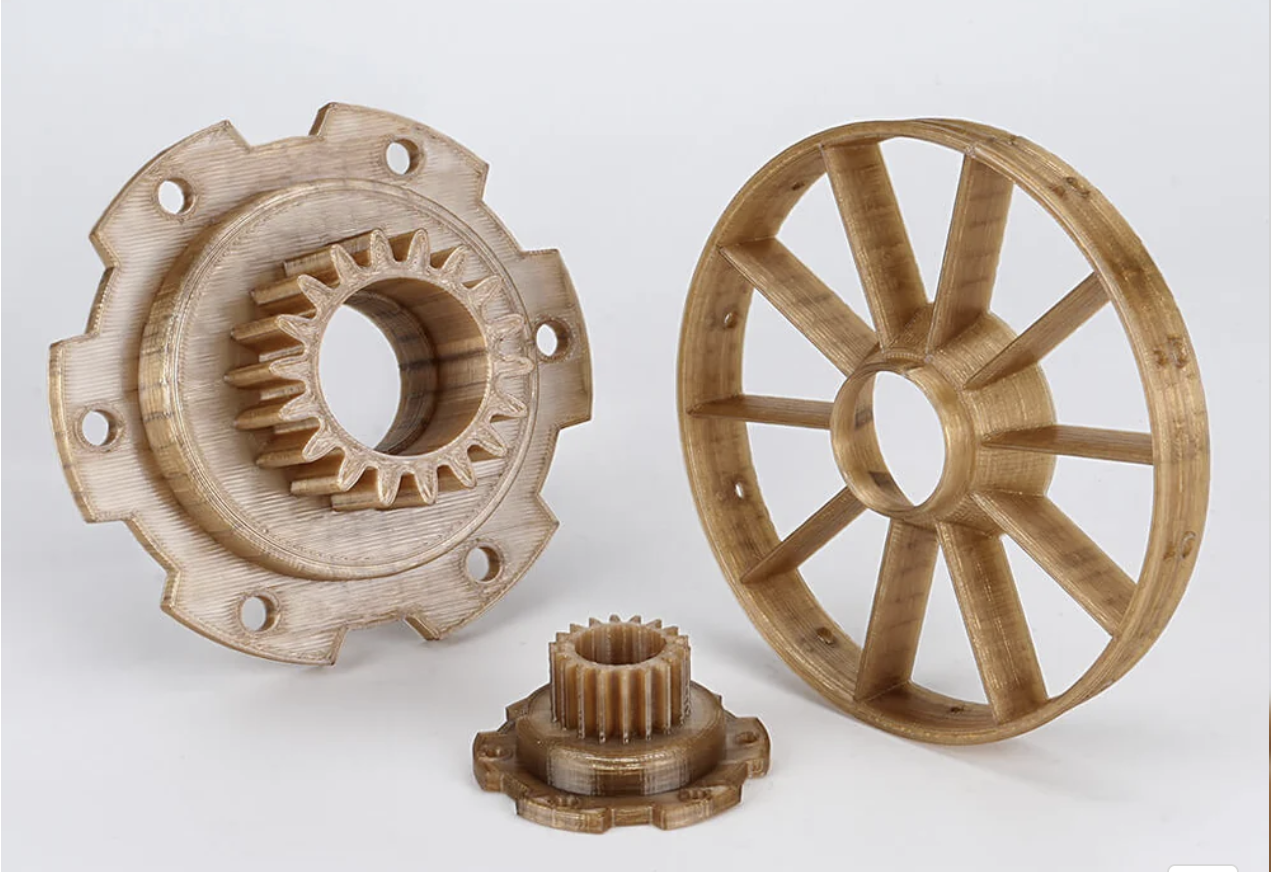
ULTEM 9085 is a flame-retardant polyetherimide (PEI) blend specifically developed for aerospace interior applications. Its material data is commonly used in FAR 25.853 flammability compliance reviews, making it one of the few thermoplastics considered for cabin-interior hardware without adding a separate flame-retardant coating.
Key Mechanical Properties
| Property | Value | Test Standard |
|---|---|---|
| Tensile Strength | 71 MPa | ASTM D638 |
| Flexural Modulus | 2,200 MPa | ASTM D790 |
| HDT (@ 1.82 MPa) | 153 °C | ASTM D648 |
| Density | 1.34 g/cm³ | ASTM D792 |
| Flame Rating | FAR 25.853 | — |
The density advantage over aluminum 6061 (~2.7 g/cm³) is significant — roughly 50% weight reduction for equivalent volume with careful DfAM.
Where ULTEM 9085 Is Used Today
- Ducting and air distribution systems — complex geometries impossible to machine
- Seat brackets and clip assemblies — low-load structural applications
- Electrical enclosures and raceway covers — fire safety critical
- Tooling and jigs — autoclave-compatible up to 175 °C short-term
# Simple weight comparison: ULTEM vs Al 6061
volume_cm3 = 250  # example part volume

density_al6061 = 2.70   # g/cm³
density_ultem  = 1.34   # g/cm³

mass_al     = volume_cm3 * density_al6061
mass_ultem  = volume_cm3 * density_ultem
savings_pct = (mass_al - mass_ultem) / mass_al * 100

print(f"Al 6061:  {mass_al:.0f} g")
print(f"ULTEM:    {mass_ultem:.0f} g")
print(f"Savings:  {savings_pct:.1f}%")
# Al 6061:  675 g
# ULTEM:    335 g
# Savings:  50.4%
PEEK: When You Need Metal Performance Without the Metal
Where ULTEM 9085 reaches its limits — sustained loads above 150 °C, aggressive chemical environments, metal-replacement in structural applications — PEEK (polyether ether ketone) takes over.
PEEK's continuous use temperature of 250 °C, combined with tensile strength exceeding 100 MPa, puts it in genuine metal-replacement territory for specific applications.
PEEK vs ULTEM vs Ti-6Al-4V
| Material | Tensile (MPa) | Density (g/cm³) | Max Temp (°C) | Cost Index |
|---|---|---|---|---|
| PEEK | 100 | 1.32 | 250 | ●●●●● |
| CF-PEEK | 210 | 1.44 | 260 | ●●●●● |
| ULTEM 9085 | 71 | 1.34 | 153 | ●●●○○ |
| Al 6061 | 310 | 2.70 | ~200 | ●●○○○ |
| Ti-6Al-4V | 950 | 4.43 | 315 | ●●●●● |
The specific strength of CF-PEEK (strength/density) rivals titanium at a fraction of the machining complexity — and additive manufacturing enables near-net-shape production with minimal waste.
Aerospace Applications for PEEK
- Engine nacelle brackets — sustained thermal environments up to 200 °C
- Hydraulic manifolds and valve bodies — chemical compatibility with Skydrol
- Radome structural elements — RF-transparent with excellent dielectric properties
- Oxygen system components — biocompatible and oxygen-clean compatible
The Qualification Path
This is where the conversation gets real. ULTEM 9085 FFF parts are used in qualified aerospace programs, but the path to flight hardware requires:
- Material qualification — coupon-level mechanical testing per ASTM standards
- Process qualification — locked print parameters, environmental controls
- First Article Inspection (FAI) — dimensional, visual, and mechanical verification
- Ongoing process monitoring — traceability of material lots and machine parameters
At Builders Generation, production programs can include material lot documentation, dimensional inspection reports, and process documentation packages. We work with your quality team to build the paper trail qualification requires.
Practical Recommendation
If you are designing an aerospace bracket or enclosure today:
- Use ULTEM 9085 if the part sees less than 140 °C sustained and requires FAR 25.853 compliance
- Use CF-PEEK if sustained temperatures exceed 180 °C, loads are significant, or metal replacement is the goal
- Use aluminum if impact loads are high, fatigue cycles are extreme (>10⁷), or the part is primary structure
The additive manufacturing route is not always the answer — but for the 40–60% of aerospace bracket and enclosure geometries that benefit from topology optimization and weight reduction, high-performance polymer AM is consistently the most effective solution.
"The question is no longer whether polymers can meet aerospace requirements. It is whether your design is sophisticated enough to take advantage of what they offer."
Reach out to discuss qualification support for your program.