The Harshest Operating Environment on Earth (or Off It)
A CubeSat in Low Earth Orbit (LEO) at 400 km altitude experiences something no terrestrial structure ever faces: 16 day/night cycles per day, with temperature swings from -180 °C in eclipse to +150 °C in direct sunlight, every 90 minutes. For a GEO satellite at 36,000 km, the thermal environment is less extreme but radiation doses are vastly higher — up to 100 krad(Si) over a 15-year design life.
This is the design environment that eliminates most materials immediately.
The Failure Modes That Matter
Before selecting a material, understand how things fail in space:
1. Thermal Cycling Fatigue
Differential CTE (coefficient of thermal expansion) between materials creates interfacial stress at every temperature cycle. A CubeSat structure may complete 87,000 thermal cycles over a 5-year mission. Any joint, bond line, or composite with a CTE mismatch will eventually delaminate or crack.
2. Atomic Oxygen Erosion (LEO)
At altitudes below 650 km, atomic oxygen (AO) flux reaches 10¹⁵ atoms/cm²/s. Unprotected polymers erode at rates measured in micrometers per year — enough to compromise thin-walled structures.
3. Radiation Damage
Total Ionizing Dose (TID) causes chain scission in most polymers, reducing molecular weight and embrittling the material. UV radiation accelerates surface degradation for materials exposed on external panels.
4. Outgassing
In vacuum, absorbed moisture and volatile organic compounds (VOCs) outgas from polymers. On optical or electronic assemblies, this contamination can be fatal.
Material Selection Matrix for Space
| Material | Thermal Range | AO Resistance | Radiation | Outgassing | Use Case |
|---|---|---|---|---|---|
| CF-PEEK | -200 to +260 °C | Moderate | Excellent | Very Low | Primary structure |
| PPSU | -100 to +180 °C | Low | Good | Low | Brackets, housings |
| PPS-CF | -60 to +220 °C | Moderate | Excellent | Very Low | Thermal components |
| ULTEM 1010 | -40 to +200 °C | Low | Good | Low | Interior structure |
| Kapton (PI film) | -269 to +400 °C | Excellent | Excellent | Very Low | Thermal blankets |
| CFRP | -180 to +180 °C | Poor (epoxy) | Good | Variable | Panels, tubes |
Why CF-PEEK Dominates CubeSat Structural Applications
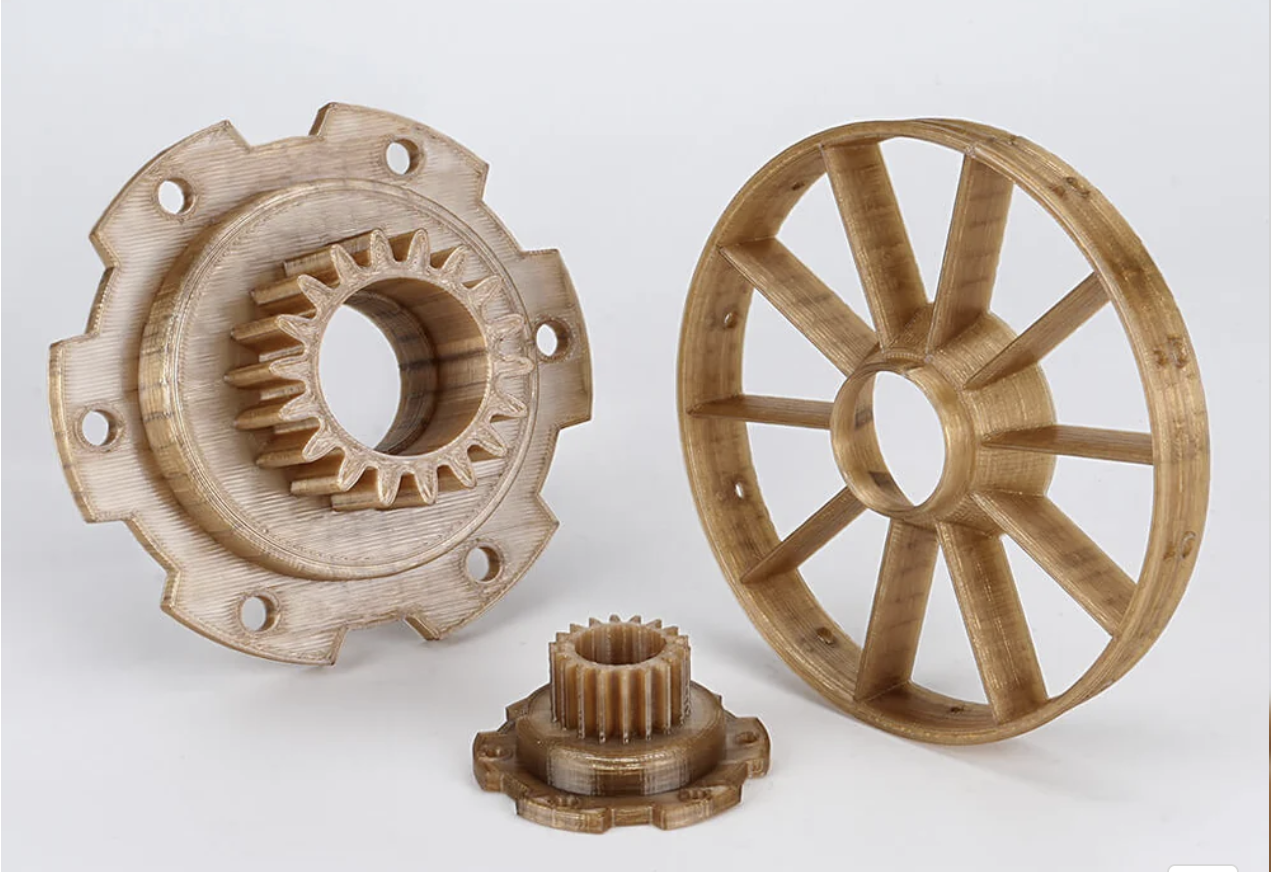
Carbon fiber reinforced PEEK offers the combination that space demands:
- CTE: 2–4 ppm/K — closely matching aluminum (23 ppm/K is the problem, not the match)
- Outgassing < 0.1% TML — well within NASA ASTM E595 requirements
- Radiation resistance — maintains 85%+ mechanical properties at 10 Mrad exposure
- Near-zero moisture absorption — stable dimensions regardless of humidity history before launch
# Thermal stress estimation at a CF-PEEK to Al interface
import numpy as np

E_cfrpeek   = 210e9    # Pa, modulus of CF-PEEK
cte_al      = 23e-6    # /K
cte_cfrpeek = 3e-6     # /K
delta_T     = 150      # K, representative LEO swing (conservative)
thickness   = 2e-3     # m, bond line region

delta_cte = abs(cte_al - cte_cfrpeek)  # 20e-6 /K
strain    = delta_cte * delta_T
stress_pa = E_cfrpeek * strain

print(f"CTE mismatch: {delta_cte*1e6:.1f} ppm/K")
print(f"Thermal strain: {strain*1e6:.0f} µε")
print(f"Induced stress: {stress_pa/1e6:.0f} MPa")
# CTE mismatch: 20.0 ppm/K
# Thermal strain: 3000 µε
# Induced stress: 630 MPa  ← this is why isolators are needed
This is why CF-PEEK-to-metal joints require isolation pads or compliant adhesive layers — the induced stress exceeds yield even for small temperature swings.
Atomic Oxygen Protection
For LEO missions, exposed polymer surfaces need AO protection. Common approaches:
- SiO₂ coating — 100–200 nm magnetron-sputtered silica, AO erosion rate near zero
- Kapton HN with SiO₂ — the industry standard for MLI blankets and solar panel substrates
- Aluminum tape overwrap — low-cost solution for non-optical surfaces
- Parylene C conformal coat — provides both AO and contamination protection
At Builders Generation, we supply CF-PEEK structural parts with dimensional inspection reports and material traceability. AO and radiation protection coatings are specified and applied by our customers' coating suppliers or at Builders Generation with partner facilities.
Practical Application: 6U CubeSat Primary Structure
A typical 6U CubeSat structure in CF-PEEK vs aluminum:
| Component | Al 6061 (g) | CF-PEEK (g) | Saving |
|---|---|---|---|
| Main rails (4×) | 48 | 22 | 54% |
| Top/bottom plates | 62 | 29 | 53% |
| Separation brackets | 18 | 9 | 50% |
| PCB standoffs (×16) | 12 | 6 | 50% |
| Total | 140 | 66 | 53% |
74 grams saved on a 6U CubeSat — significant when total launch mass may be under 12 kg and launch cost is $5,000–$15,000/kg to LEO.
Outgassing Compliance
NASA ASTM E595 requires:
- TML (Total Mass Loss) ≤ 1.0%
- CVCM (Collected Volatile Condensable Material) ≤ 0.1%
CF-PEEK and PPS-CF both meet these requirements without bakeout. ULTEM 1010 typically requires a 24–48 hour vacuum bakeout at 120 °C to achieve compliance. Standard FFF nylons do not meet E595 and should not be used in any outgassing-sensitive space assembly.
If your CubeSat structural margins are tight, the first question to ask is not "can we afford CF-PEEK?" — it is "can we afford not to use it?"
Contact us for material lot documentation and traceability packages for space-grade parts.