The Gap Between "Can Print" and "Should Print"
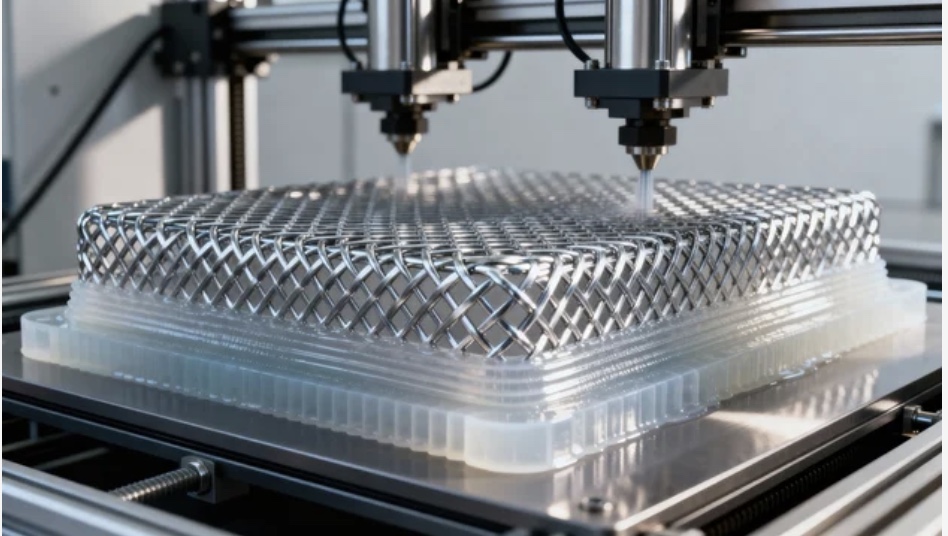
Every mid-range FFF printer capable of 350 °C nozzle temperatures is now marketed as "PEEK-capable." This is technically true and practically misleading. The mechanical properties of PEEK parts are extraordinarily sensitive to print parameters — and the difference between a well-tuned PEEK print and a poorly tuned one is not a few percent variation. It is the difference between a part that meets aerospace requirements and one that fails in thermal cycling.
This article covers the process science behind high-performance PEEK printing, the design rules that enable consistent results, and the test data that validates them.
Why PEEK Is Difficult
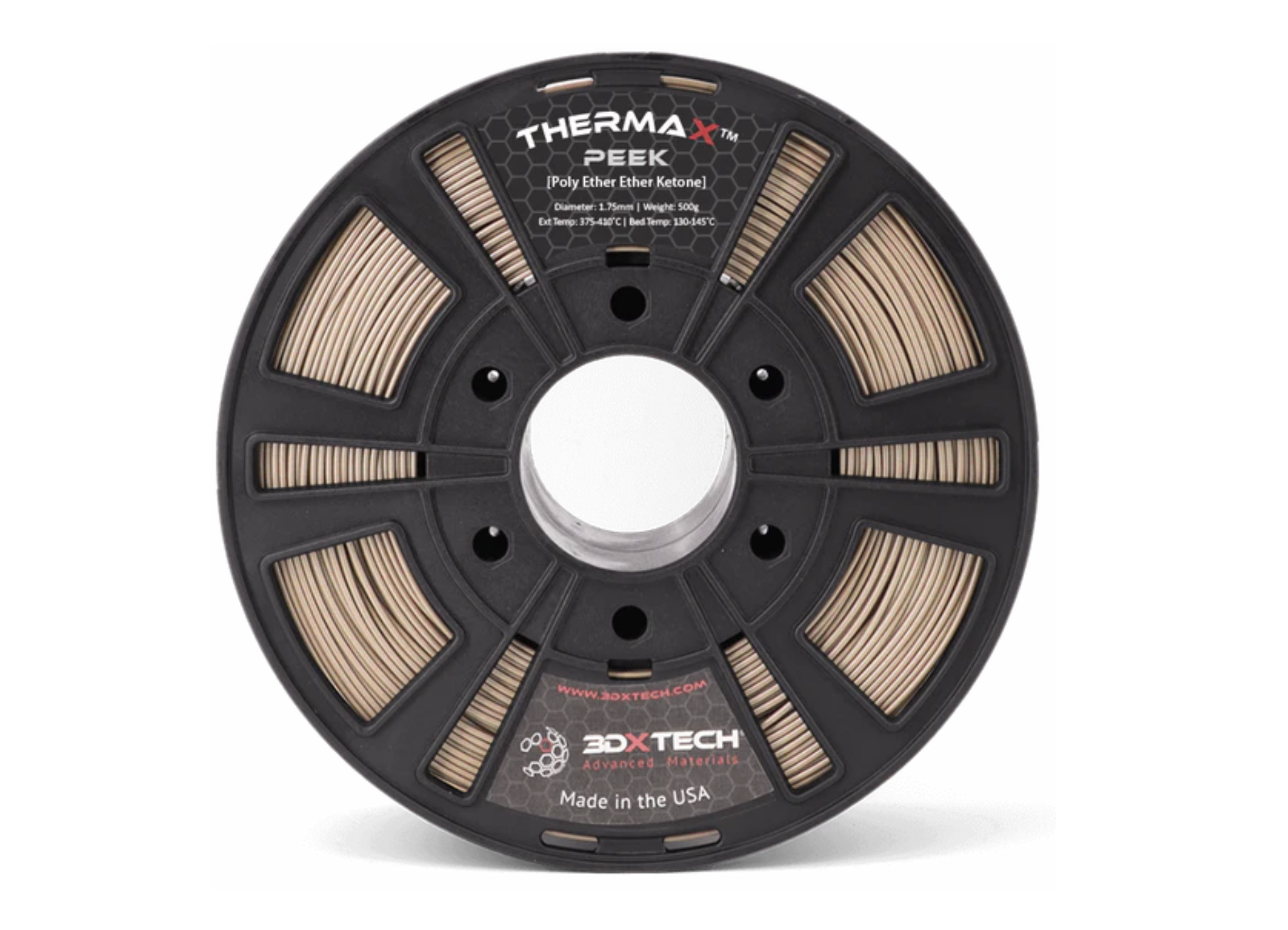
PEEK crystallizes. This is both its strength and the source of most printing failures.
Semi-crystalline PEEK (as opposed to the amorphous form) has a tensile strength of ~100 MPa and a flexural modulus of ~4,100 MPa. Amorphous PEEK — which is what you get when PEEK melt cools too fast — has a tensile strength of ~91 MPa and a modulus of ~3,600 MPa. The difference sounds modest until you consider that the crystalline form also has dramatically better fatigue resistance, chemical resistance, and thermal stability.
The challenge: PEEK requires controlled thermal processing above its glass transition (Tg ≈ 143 °C) to manage crystallinity after extrusion. Industrial workflows may use elevated chamber temperatures, controlled bed temperatures, and post-print annealing; the exact process window depends on material supplier, machine class, geometry, and acceptance criteria.
Representative Thermal Controls
| Parameter | Typical Control | Notes |
|---|---|---|
| Nozzle temperature | 420–450 °C class | Material-specific |
| Bed temperature | Elevated | Machine and adhesion-stack specific |
| Chamber temperature | Controlled heated chamber | Qualified by material, geometry, and acceptance criteria |
| Cooling | Minimal / controlled | Forced air can reduce crystallinity |
| Annealing (post-print) | Controlled oven cycle | Set by material supplier guidance and dimensional requirements |
Printers with inadequate chamber control may produce parts that look acceptable at room temperature but creep, warp, or lose mechanical margin at elevated temperature because crystallinity was not controlled.
VisionMiner 22 IDEX v4: Why It Matters for PEEK
Our VisionMiner 22 IDEX v4 is a purpose-built high-temperature FFF system. The combination of a 500 °C all-metal hot end, controlled heated chamber, and IDEX dual extrusion supports high-performance polymer workflows that are not practical on modified desktop machines.
# Print parameter planning — PEEK on a high-temperature FFF system
params = {
    "nozzle_temp":       430,    # °C
    "bed_temp":          165,    # °C
    "chamber_profile":   "qualified per material and geometry",
    "print_speed":        25,    # mm/s (slower = better layer adhesion)
    "layer_height":      0.15,   # mm (0.4 mm nozzle)
    "line_width":         0.42,  # mm
    "infill":             100,   # % for structural parts
    "wall_count":           6,   # outer perimeters
    "cooling":           False,  # NO cooling for PEEK
    "support":     "breakaway",  # support interface material: PPS or ULTEM
}

# Cooling rate below Tg affects crystallinity.
# Chamber profile and annealing plan should be validated against the supplier data,
# part geometry, and acceptance criteria.

print("Estimated volumetric flow rate:")
flow = params["print_speed"] * params["layer_height"] * params["line_width"]
print(f"  {flow:.3f} mm³/s — within VisionMiner capability")
Anisotropy: The Unavoidable FFF Limitation
All FFF parts have anisotropic mechanical properties. For PEEK, this is a design consideration that cannot be ignored in flight hardware applications.
Representative Mechanical Properties: Build Orientation Effect
Values below are representative and vary by supplier, machine, orientation, post-processing, and test standard.
| Test Direction | Tensile Strength | Elongation |
|---|---|---|
| XY (along layer, perpendicular to deposition) | 98 MPa | 2.8% |
| XY (along deposition direction) | 95 MPa | 2.6% |
| Z (through layer, cross-section) | 61 MPa | 1.4% |
| Injection molded reference | 100 MPa | 3.5% |
The Z-direction strength is 38% lower than XY. This is the inter-layer bond strength — determined by the thermal diffusion between deposited layers.
Design Rule: Orient Critical Load Paths in XY
For any PEEK part with a known primary load path, orient the build so that primary tensile stress acts in the XY plane — not through the Z-axis. For brackets, this typically means:
- Build with the largest flat face on the bed
- Orient the attachment point faces normal to the Z-axis
- Design fillets and radii in the XY plane where possible
# Load path orientation check
def check_orientation(load_vector, build_z=(0, 0, 1)):
    """
    Check if a load vector has significant Z-component.
    Returns fraction of load in Z direction.
    """
    import numpy as np
    load = np.array(load_vector, dtype=float)
    load_normalised = load / np.linalg.norm(load)
    z_component = abs(np.dot(load_normalised, build_z))
    return z_component

# Example: primary load is 450 N in Y, 150 N in Z
primary_load = [0, 450, 150]
z_fraction = check_orientation(primary_load)
print(f"Z-fraction of primary load: {z_fraction:.2%}")
if z_fraction > 0.20:
    print("⚠ Consider reorienting — significant Z-direction loading")
else:
    print("✓ Orientation acceptable")
Post-Print Annealing Plan
Even with correct chamber control during printing, a post-print anneal cycle can improve properties by increasing crystallinity and relieving internal stresses.
Representative plan:
- Remove part from printer — do not force-cool
- Transfer to circulating air oven within 15 minutes (while part is still warm)
- Ramp to 200 °C at 2 °C/min
- Soak at 200 °C for 2 hours
- Ramp down to room temperature at 1 °C/min (slow cool is critical)
- Dimensional inspection — expect < 0.3% linear shrinkage
The validated anneal plan should be tied to material supplier guidance, coupon data when required, and dimensional acceptance criteria.
First Article Planning: PEEK Bracket, LEO Satellite Application
A qualification-aware first article plan for a LEO Earth observation bracket might track:
| Test | Example Requirement | Example Record | Status |
|---|---|---|---|
| Tensile (XY) | Defined by program | Coupon test report | Pass/fail by requirement |
| Tensile (Z) | Defined by program | Coupon test report | Pass/fail by requirement |
| HDT (@ 1.82 MPa) | Defined by program | Supplier or coupon data | Pass/fail by requirement |
| Dimensional (GD&T) | Customer drawing | Inspection report | Pass/fail by requirement |
| Outgassing TML | ≤ 1.0% when ASTM E595 applies | Supplier or lab data | Pass/fail by requirement |
| Outgassing CVCM | ≤ 0.1% when ASTM E595 applies | Supplier or lab data | Pass/fail by requirement |
| Thermal cycling | Program-specific range and cycles | Test report | Pass/fail by requirement |
When to Use CF-PEEK Instead
For most structural applications, CF-PEEK outperforms neat PEEK on a specific stiffness basis:
| Property | PEEK | CF-PEEK |
|---|---|---|
| Flexural Modulus | 4,100 MPa | 14,000 MPa |
| Tensile Strength | 100 MPa | 210 MPa |
| Density | 1.32 g/cm³ | 1.44 g/cm³ |
| Specific Stiffness | 3,106 | 9,722 |
Use neat PEEK when:
- Outgassing requirements are extreme (CF-PEEK outgasses slightly more)
- RF transparency is required (carbon fiber is conductive)
- Biocompatibility documentation is required (for example, ISO 10993 material data)
Use CF-PEEK when high specific stiffness is the dominant objective and conductivity is acceptable.
PEEK printing is a process discipline, not a materials trick. The correct hardware, validated parameters, and post-print protocol are what separate test specimens from production parts.
Contact us to discuss qualification support, first article testing, and documentation for your PEEK program.