What "Defense Grade" Actually Means for Polymer Selection
When a defense program specifies "mil-spec," it usually refers to MIL-STD-810 — the environmental testing standard that governs shock, vibration, temperature, humidity, altitude, and sand/dust exposure. A housing or bracket that passes MIL-STD-810G Method 514.8 (vibration) and Method 516.8 (shock) is qualified for fielded use. Many civilian polymer specifications are never tested to this standard. Defense applications require materials that perform reliably across these axes simultaneously.
This article covers the materials that make the grade and the design practices that get them there.
Operating Environment Matrix
Defense hardware operates across a brutal range of environments:
| Environment | Specification | Example |
|---|---|---|
| Temperature (operating) | -51 °C to +71 °C | MIL-STD-810 Method 501/502 |
| Temperature (storage) | -62 °C to +85 °C | Mil Cat A2 |
| Humidity | 95% RH, 50 °C, 10 days | Method 507 |
| Vibration | 7.7 Grms, 20–2000 Hz | Method 514 |
| Shock | 40 G, 11 ms half-sine | Method 516 |
| Drop (1 m onto concrete) | All axes + corners | Method 516 |
| Salt fog | 96 hours continuous | Method 509 |
| Fungal resistance | 28 days, 8 strains | Method 508 |
No metallic housing automatically passes all of these — and neither does an arbitrary polymer.
Material Selection: Defense Applications
PC-CF (Polycarbonate + Carbon Fiber) — Soldier-Worn Hardware
PC-CF combines the legendary impact toughness of polycarbonate with the stiffness boost of short carbon fiber reinforcement. The result is a material that absorbs drop shock, resists flex under load, and survives the temperature range of a deployed environment.
| Property | Value |
|---|---|
| Tensile Strength | 131 MPa |
| Flexural Modulus | 5,320 MPa |
| Charpy Impact | 28 kJ/m² |
| HDT (@ 1.82 MPa) | 205 °C |
| Cold Temperature Performance | Ductile to -40 °C |
Applications: Rifle optic mounts, body-worn radio housings, helmet-mounted device brackets, sighting system enclosures.
The critical advantage: PC-CF remains ductile at -40 °C — the point where many unreinforced polymers become brittle. A radio housing that cracks when dropped in Norwegian winter conditions is a mission failure.
PPS-CF (Polyphenylene Sulfide + Carbon Fiber) — Extreme Environments
PPS-CF is the correct choice when the operating environment involves chemical exposure (fuels, lubricants, hydraulic fluid, decontaminants) combined with sustained heat.
# Chemical resistance scoring: higher = better
materials = {
    "PPS-CF":   {"Jet-A fuel": 5, "MIL-PRF-5606 hydraulic": 5, "CARC solvent": 4, "Sodium hydroxide": 5},
    "PC-CF":    {"Jet-A fuel": 3, "MIL-PRF-5606 hydraulic": 3, "CARC solvent": 2, "Sodium hydroxide": 2},
    "Nylon 12": {"Jet-A fuel": 4, "MIL-PRF-5606 hydraulic": 4, "CARC solvent": 3, "Sodium hydroxide": 2},
    "ABS":      {"Jet-A fuel": 2, "MIL-PRF-5606 hydraulic": 2, "CARC solvent": 1, "Sodium hydroxide": 1},
}

for mat, scores in materials.items():
    avg = sum(scores.values()) / len(scores)
    print(f"{mat:15} avg resistance: {avg:.1f}/5")

# PPS-CF          avg resistance: 4.8/5  ← clear winner
# Nylon 12        avg resistance: 3.3/5
# PC-CF           avg resistance: 2.5/5
# ABS             avg resistance: 1.5/5
Applications: Ground vehicle sensor pods, engine bay brackets, hydraulic system components, NBC (nuclear/biological/chemical) decontamination-resistant housings.
ULTEM 1010 — UAV Airframe Internals
ULTEM 1010 is the biocompatible, food-safe variant of the PEI family — but in defense applications its advantage is its high continuous use temperature (215 °C) combined with excellent mechanical properties and UL94 V-0 flame rating.
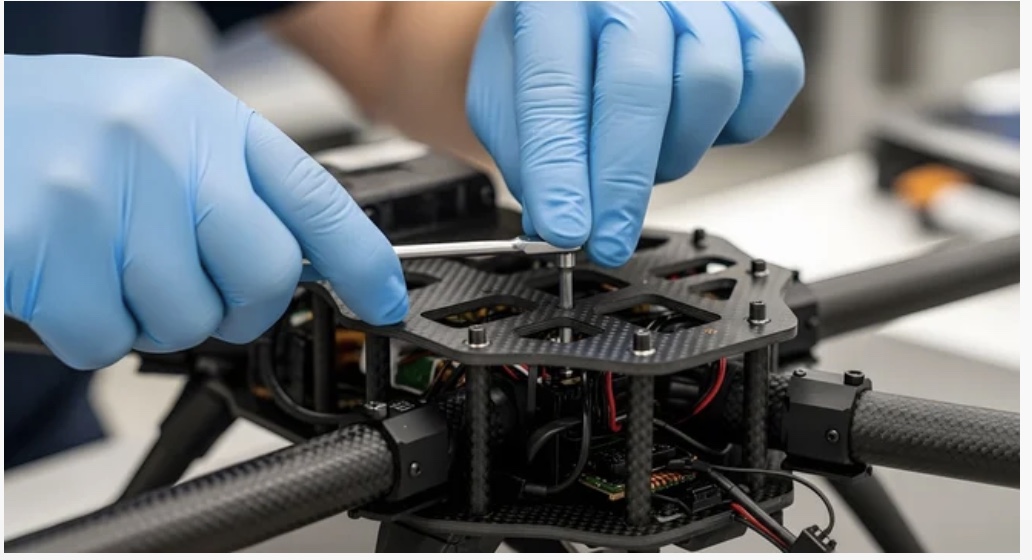
For small UAS (sUAS) and SUAS-class platforms, ULTEM 1010 printed brackets and internal structure offer the fire resistance required for battery-adjacent components and the mechanical performance needed for multi-G maneuvers.
Topology Optimization for Defense Hardware
The most significant advantage of additive manufacturing in defense applications is not the material — it is the geometry freedom. Topology-optimized brackets designed for additive manufacture consistently achieve 40–65% weight reduction versus machined equivalents while meeting or exceeding the original load requirements.
Example: UAV Gimbal Mount
A conventional machined aluminum gimbal mount for a 600 g EO/IR payload typically weighs 85–110 g. A topology-optimized CF-PEEK equivalent, designed for additive manufacture, typically comes in at 35–45 g — without sacrificing stiffness or natural frequency targets (which must stay above the primary vibration modes of the airframe).
The process:
- Define load cases — hover, forward flight, max-g maneuver, landing shock
- Set constraints — attachment interfaces, cable routing keep-outs, minimum wall thickness
- Run FEA topology optimization — Altair OptiStruct or nTopology
- Interpret and smooth — additive-ready geometry
- Validate — FEA confirmation of final geometry
- Print and test — first article, then qualification
Qualification and Traceability
Defense programs require supply chain documentation that commercial programs do not. At a minimum:
- Material Certificate of Conformance (CoC) — confirming lot traceability to the material manufacturer
- Dimensional Inspection Report — GD&T verification of critical features
- Process Parameter Record — locked print settings, machine ID, environmental log
- First Article Inspection (FAI) Report — per AS9102 or contractual equivalent
Builders Generation provides complete documentation packages for all defense-adjacent production runs. Contact us to discuss your program's specific quality requirements.
High-performance polymer composites are not a compromise in defense applications. They are a capability multiplier — enabling geometries, weight budgets, and production speeds that conventional machining cannot match.